What Are Flax Seed Used in Arts Crafts

Flax, flax seeds, linseed oil, linseed block
Linseed oil, also known every bit flaxseed oil or flax oil (in its edible class), is a colourless to yellowish oil obtained from the stale, ripened seeds of the flax plant (Linum usitatissimum). The oil is obtained by pressing, sometimes followed by solvent extraction. Linseed oil is a drying oil, meaning it tin polymerize into a solid class. Owing to its polymer-forming properties, linseed oil can exist used on its own or composite with combinations of other oils, resins or solvents as an impregnator, drying oil finish or varnish in woods finishing, equally a paint binder in oil paints, as a plasticizer and hardener in putty, and in the manufacture of linoleum. Linseed oil utilise has declined over the past several decades with increased availability of constructed alkyd resins—which function similarly merely resist yellowing.[1]
Linseed oil is an edible oil in demand as a dietary supplement, as a source of α-Linolenic acid, (an omega-3 fatty acid). In parts of Europe, information technology is traditionally eaten with potatoes and quark. It is regarded as a delicacy due to its hearty taste and ability to improve the bland flavour of quark.[two]
Structure and limerick [edit]
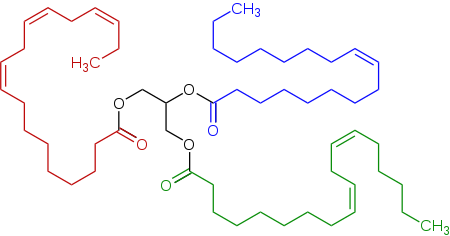
Linseed oil is a triglyceride, like other fats. Linseed oil is distinctive for its unusually large amount of α-linolenic acid, which has a distinctive reaction with oxygen in air. Specifically, the fatty acids in a typical linseed oil are of the following types:[3]
- The triply unsaturated α-linolenic acid (51.9–55.ii%),
- The saturated acids palmitic acid (near seven%) and stearic acrid (iii.four–four.6%),
- The monounsaturated oleic acid (18.v–22.six%),
- The doubly unsaturated linoleic acid (14.ii–17%).
Drying properties [edit]
Having a high content of di- and tri-unsaturated esters, linseed oil is peculiarly susceptible to polymerization reactions upon exposure to oxygen in air. This polymerization, which is called "drying", results in the rigidification of the material. To forbid premature drying, linseed oil-based products (oil paints, putty) are stored in airtight containers.
Rags soaked with linseed oil stored pose fire run a risk because they provide a large surface area for rapid oxidation. The oxidation of linseed oil is exothermic, which may lead to spontaneous combustion.[4] In 1991, 1 Top Plaza, a high rise in Philadelphia, was severely damaged in a fire, in which 3 firefighters perished, thought to be caused by rags soaked with linseed oil.[5]
Applications [edit]
Most applications of linseed oil exploit its drying properties, i.e., the initial material is liquid or at least pliable and the aged material is rigid but not brittle. The h2o-repelling (hydrophobic) nature of the resulting hydrocarbon-based cloth is advantageous.[ citation needed ]
Paint binder [edit]

"Your country needs flax .." U.Due south. WWII poster soliciting linseed oil for use in paint

A tin of French linseed oil.
Linseed oil is the carrier used in oil paint. It can also be used as a painting medium, making oil paints more than fluid, transparent and glossy. Information technology is available in varieties such as cold-pressed, alkali-refined, sun-bleached, lord's day-thickened, and polymerised (stand up oil). The introduction of linseed oil was a significant accelerate in the technology of oil painting.[ citation needed ]
Putty [edit]
Traditional glazing putty, consisting of a paste of chalk pulverization and linseed oil, is a sealant for glass windows that hardens inside a few weeks of application and can then exist painted over. The durability of putty is owed to the drying backdrop of linseed oil.[ commendation needed ]
Wood finish [edit]
When used as a wood terminate, linseed oil dries slowly and shrinks little upon hardening. Linseed oil does not cover the surface equally varnish does, merely soaks into the (visible and microscopic) pores, leaving a shiny but not glossy surface that shows off the grain of the wood. A linseed oil finish is hands scratched, and easily repaired. Only wax finishes are less protective. Liquid water penetrates a linseed oil cease in mere minutes, and water vapour bypasses it almost completely.[half-dozen] Garden article of furniture treated with linseed oil may develop mildew. Oiled wood may be yellowish and is likely to darken with age. Considering information technology fills the pores, linseed oil partially protects wood from denting by compression.[ commendation needed ]
Linseed oil is a traditional finish for firearm stocks, though very fine finish may crave months to obtain. Several coats of linseed oil is the traditional protective blanket for the raw willow wood of cricket bats; it is used so that the wood retains some moisture. New cricket bats are coated with linseed oil and knocked-in to perfection and then that they last longer. Linseed oil is also often used by billiards or pool cue-makers for cue shafts, as a lubricant/protectant for wooden recorders, and used in place of epoxy to seal modern wooden surfboards.[ citation needed ]
Additionally, a luthier may use linseed oil when reconditioning a guitar, mandolin, or other stringed musical instrument'southward fret board; lemon-scented mineral oil is unremarkably used for cleaning, so a calorie-free amount of linseed oil (or other drying oil) is applied to protect it from grime that might otherwise result in accelerated deterioration of the wood.[ commendation needed ]
Gilding [edit]
Boiled linseed oil is used as sizing in traditional oil gilding to adhere sheets of gilt leaf to a substrate (parchment, canvas, Armenian bole, etc.). It has a much longer working time than h2o-based size and gives a firm polish surface that is adhesive enough in the first 12–24 hours after application to cause the gold to attach firmly to the intended surface.[ citation needed ]
Linoleum [edit]
Linseed oil is used to bind wood grit, cork particles, and related materials in the manufacture of the floor covering linoleum. After its invention in 1860 by Frederick Walton, linoleum, or 'lino' for short, was a mutual form of domestic and industrial flooring roofing from the 1870s until the 1970s when it was largely replaced past PVC ('vinyl') floor coverings.[7] Notwithstanding, since the 1990s, linoleum is returning to favor, beingness considered more environmentally sound than PVC.[8] Linoleum has given its proper noun to the printmaking technique linocut, in which a relief design is cutting into the smoothen surface and then inked and used to print an epitome. The results are similar to those obtained by woodcut printing.[ citation needed ]
Nutritional supplement and nutrient [edit]
Raw cold-pressed linseed oil – commonly known as flax seed oil in nutritional contexts – is hands oxidized, and speedily becomes rancid, with an unpleasant odor, unless refrigerated. Linseed oil is not generally recommended for use in cooking. Blastoff linolenic acid (ALA) while jump to flaxseed ALA can withstand temperatures up to 175 °C (350 °F) for 2 hours.[9]
Nutrient-grade flaxseed oil is common cold-pressed, obtained without solvent extraction, in the absence of oxygen, and marketed every bit edible flaxseed oil. Fresh, refrigerated and unprocessed, linseed oil is used as a nutritional supplement and is a traditional European ethnic nutrient, highly regarded for its nutty flavor. Regular flaxseed oil contains between 57% and 71% polyunsaturated fats (blastoff-linolenic acid, linoleic acid).[10] Found breeders have developed flaxseed with both higher ALA (70%)[ten] and very low ALA content (< iii%).[11] The USFDA granted generally recognized as safe (GRAS) status for high alpha linolenic flaxseed oil.[12]
Nutrient content [edit]
| Typical fatty acrid content | % [13] | % European[14] |
|---|---|---|
| Palmitic acid | 6.0 | four.0–six.0 |
| Stearic acrid | ii.5 | 2.0–iii.0 |
| Arachidic acid | 0.5 | 0–0.v |
| Palmitoleic acid | - | 0–0.5 |
| Oleic acrid | nineteen.0 | 10.0–22.0 |
| Eicosenoic acid | - | 0–0.half-dozen |
| Linoleic acid | 24.1 | 12.0–18.0 |
| Alpha-linolenic acid | 47.4 | 56.0–71.0 |
| Other | 0.5 | - |
Nutrition information from the Flax Council of Canada.[xv]
Per i tbsp (14 g)
- Calories: 126
- Total fatty: 14 m
- Omega-iii: 8 thousand
- Omega-6: ii g
- Omega-9: three m
Flax seed oil contains no significant amounts of poly peptide, carbohydrates or fibre.
Comparison to other vegetable oils [edit]
| Type | Processing treatment[18] | Saturated fatty acids | Monounsaturated fatty acids | Polyunsaturated fatty acids | Smoke indicate | ||||
|---|---|---|---|---|---|---|---|---|---|
| Total[16] | Oleic acid (ω-ix) | Total[16] | α-Linolenic acid (ω-three) | Linoleic acid (ω-6) | ω-half dozen:3 ratio | ||||
| Avocado[19] | 11.vi | 70.6 | 52–66[20] | thirteen.5 | 1 | 12.five | 12.5:one | 250 °C (482 °F)[21] | |
| Brazil nut[22] | 24.8 | 32.7 | 31.3 | 42.0 | 0.one | 41.ix | 419:1 | 208 °C (406 °F)[23] | |
| Canola[24] | 7.iv | 63.three | 61.8 | 28.1 | 9.ane | eighteen.6 | 2:1 | 238 °C (460 °F)[23] | |
| Coconut[25] | 82.5 | vi.iii | 6 | i.7 | 175 °C (347 °F)[23] | ||||
| Corn[26] | 12.9 | 27.6 | 27.3 | 54.7 | 1 | 58 | 58:1 | 232 °C (450 °F)[27] | |
| Cottonseed[28] | 25.9 | 17.eight | 19 | 51.9 | i | 54 | 54:one | 216 °C (420 °F)[27] | |
| Flaxseed/linseed[29] | 9.0 | xviii.4 | 18 | 67.8 | 53 | 13 | 0.ii:1 | 107 °C (225 °F) | |
| Grape seed | ten.5 | fourteen.3 | xiv.3 | 74.7 | – | 74.7 | very high | 216 °C (421 °F)[30] | |
| Hemp seed[31] | vii.0 | 9.0 | ix.0 | 82.0 | 22.0 | 54.0 | two.five:one | 166 °C (330 °F)[32] | |
| Olive[33] | 13.8 | 73.0 | 71.three | 10.v | 0.7 | ix.viii | 14:ane | 193 °C (380 °F)[23] | |
| Palm[34] | 49.iii | 37.0 | twoscore | 9.3 | 0.two | 9.1 | 45.5:1 | 235 °C (455 °F) | |
| Peanut[35] | 16.two | 57.1 | 55.4 | 19.9 | 0.318 | 19.half-dozen | very high | 232 °C (450 °F)[27] | |
| Rice bran oil | 25 | 38.iv | 2.ii | 34.4[36] | 15.half dozen | 232 °C (450 °F)[37] | |||
| Loftier-oleic safflower oil[38] | 7.v | 75.2 | 75.2 | 12.viii | 0 | 12.8 | very high | 212 °C (414 °F)[23] | |
| Sesame[39] | ? | xiv.ii | 39.7 | 39.3 | 41.7 | 0.three | 41.three | 138:1 | |
| Soybean[40] | partially hydrogenated | fourteen.9 | 43.0 | 42.5 | 37.half dozen | 2.half-dozen | 34.9 | 13.4:1 | |
| Soybean[41] | 15.half-dozen | 22.eight | 22.6 | 57.7 | seven | 51 | 7.3:1 | 238 °C (460 °F)[27] | |
| Walnut oil[42] | unrefined | nine.1 | 22.8 | 22.ii | 63.three | 10.4 | 52.9 | 5:1 | 160 °C (320 °F)[43] |
| Sunflower[44] | 8.99 | 63.iv | 62.ix | 20.vii | 0.sixteen | 20.5 | very high | 227 °C (440 °F)[27] | |
| Cottonseed[45] | hydrogenated | 93.6 | 1.five | 0.6 | 0.2 | 0.iii | i.five:one | ||
| Palm[46] | hydrogenated | 88.two | v.7 | 0 | |||||
| The nutritional values are expressed as percent (%) by mass of total fat. | |||||||||
Additional uses [edit]
- Animal care products
- Wheel maintenance as a thread fixative, rust inhibitor and lubricant
- Limerick ornament for moulded decoration
- Earthen floors
- Creature feeds
- Industrial lubricant
- Leather handling
- Oilcloth
- Particle detectors[47]
- Textiles
- Wood preservation (including as an active ingredient of Danish oil)
- Cookware seasoning
- Establish protection[48]
Modified linseed oils [edit]
Stand oil [edit]
Stand oil is generated by heating linseed oil near 300 °C for a few days in the consummate absence of air. Under these weather, the polyunsaturated fat esters catechumen to conjugated dienes, which so undergo Diels-Alder reactions, leading to crosslinking. The product, which is highly glutinous, gives highly compatible coatings that "dry" to more elastic coatings than linseed oil itself. Soybean oil can be treated similarly, but converts more slowly. On the other hand, tung oil converts very quickly, being consummate in minutes at 260 °C. Coatings prepared from stand oils are less prone to yellowing than are coatings derived from the parent oils.[49]
Boiled linseed oil [edit]
Boiled linseed oil is a combination of raw linseed oil, stand oil (see in a higher place), and metallic oil drying agents (catalysts to advance drying).[49] In the Medieval era, linseed oil was boiled with pb oxide (litharge) to requite a product called boiled linseed oil.[50] [ folio needed ] The lead oxide forms lead "soaps" (lead oxide is alkaline) which promotes hardening (polymerisation) of linseed oil past reaction with atmospheric oxygen. Heating shortens its drying time.[ citation needed ]
Raw linseed oil [edit]
Raw linseed oil is the base oil, unprocessed and without driers or thinners. It is generally used every bit a feedstock for making a boiled oil. It does not cure sufficiently well or speedily to be regarded as a drying oil.[51] Raw linseed is sometimes used for oiling cricket bats to increment surface friction for better ball control.[52] Information technology was likewise used to treat leather flat belt drives to reduce slipping.[ citation needed ]
See likewise [edit]
- Danish oil
- Flax seed
- National Linseed Oil Trust
- Smoke point
References [edit]
- ^ Jones, Frank Due north. (2003). "Alkyd Resins". Ullmann'due south Encyclopedia of Industrial Chemistry. doi:x.1002/14356007.a01_409. ISBN978-3527306732.
- ^ "Rezept Kartoffeln mit Leinoel".
- ^ Vereshchagin, A. G.; Novitskaya, Galina Five. (1965). "The triglyceride composition of linseed oil". Journal of the American Oil Chemists' Gild. 42 (11): 970–974. doi:10.1007/BF02632457. PMID 5898097. S2CID 29785363.
- ^ Ettling, Bruce V.; Adams, Mark F. (1971). "Spontaneous combustion of linseed oil in sawdust". Fire Engineering science. 7 (3): 225. doi:10.1007/BF02590415. S2CID 109500727.
- ^ Routley, J. Gordon; Jennings, Charles; Chubb, Mark (February 1991), "Highrise Office Building Burn down One Meridian Plaza Philadelphia, Pennsylvania" (PDF), Report USFA-TR-049, Federal Emergency Management Agency
- ^ Flexner, Bob. Understanding Wood Finishing. Reader's Digest Association, Inc., 2005, p. 75.
- ^ Due south. Diller and J. Diller, Craftsman's Construction Installation Encyclopedia, Craftsman Book Company, 2004, p. 503
- ^ Julie Thou. Rayfield, The Part Interior Design Guide: An Introduction for Facility and Design Professionals, John Wiley & Sons, 1994, p. 209
- ^ Chen, Z. Y.; Ratnayake, W. M. Due north.; Cunnane, S. C. (1994). "Oxidative stability of flaxseed lipids during baking". Periodical of the American Oil Chemists' Guild. 71 (vi): 629–632. doi:x.1007/BF02540591. S2CID 84981982.
- ^ a b Morris, Diane H. (2007). "Affiliate 1: Description and Limerick of Flax; In: Flax – A Health and Diet Primer". Flax Council of Canada. Retrieved 16 September 2019.
- ^ Thompson, Lilian U.; Cunnane, Stephen C., eds. (2003). Flaxseed in human nutrition (2nd ed.). AOCS Press. pp. 8–11. ISBN978-1-893997-38-7.
- ^ "U.S. FDA/CFSAN Agency Response Letter of the alphabet GRAS Detect No. GRN 00256". U.S. FDA/CFSAN. Retrieved 2013-01-29 .
- ^ "Linseed" (PDF). Interactive European Network for Industrial Crops and their Applications. Oct xiv, 2002. Archived from the original (PDF) on September 27, 2007. Retrieved 2008-01-24 .
- ^ Deutsche Gesellschaft für Fettwissenschaft (see 'Leinöl Europa': Fettsäurezusammensetzung wichtiger pflanzlicher und tierischer Speisefette und -öle Archived 2008-12-22 at the Wayback Machine (PDF)
- ^ "Flax - A Salubrious Nutrient". Flax Council of Canada. Archived from the original on 2011-07-06. Retrieved 2008-01-24 .
- ^ a b c "Usa National Nutrient Database, Release 28". United States Section of Agriculture. May 2016. All values in this tabular array are from this database unless otherwise cited.
- ^ "Fats and fat acids contents per 100 thousand (click for "more details"). Instance: Avocado oil (user can search for other oils)". Nutritiondata.com, Conde Nast for the USDA National Food Database, Standard Release 21. 2014. Retrieved 7 September 2017. Values from Nutritiondata.com (SR 21) may need to be reconciled with near recent release from the USDA SR 28 every bit of Sept 2017.
- ^ "USDA Specifications for Vegetable Oil Margarine Effective August 28, 1996" (PDF).
- ^ "Avocado oil, fat composition, 100 g". U.s. National Food Database, Release 28, Usa Department of Agriculture. May 2016. Retrieved vi September 2017.
- ^ Feramuz Ozdemir; Ayhan Topuz (May 2003). "Changes in dry matter, oil content and fatty acids composition of avocado during harvesting time and mail service-harvesting ripening menstruum" (PDF). Elsevier. Retrieved xv January 2020.
- ^ Marie Wong; Cecilia Requejo-Jackman; Allan Woolf (April 2010). "What is unrefined, extra virgin cold-pressed avocado oil?". Aocs.org. The American Oil Chemists' Society. Retrieved 26 December 2019.
- ^ "Brazil nut oil, fat composition, 100 g". United states National Nutrient Database, Release 28, United States Department of Agriculture. May 2016. Retrieved half-dozen September 2017.
- ^ a b c d e Katragadda, H. R.; Fullana, A. S.; Sidhu, Southward.; Carbonell-Barrachina, Á. A. (2010). "Emissions of volatile aldehydes from heated cooking oils". Food Chemistry. 120: 59–65. doi:x.1016/j.foodchem.2009.09.070.
- ^ "Canola oil, fatty composition, 100 g". Usa National Nutrient Database, Release 28, U.s.a. Section of Agriculture. May 2016. Retrieved 6 September 2017.
- ^ "Coconut oil, fatty composition, 100 grand". US National Nutrient Database, Release 28, United States Section of Agriculture. May 2016. Retrieved vi September 2017.
- ^ "Corn oil, industrial and retail, all purpose salad or cooking, fat composition, 100 g". The states National Food Database, Release 28, United States Section of Agriculture. May 2016. Retrieved 6 September 2017.
- ^ a b c d e Wolke, Robert Fifty. (May 16, 2007). "Where In that location'south Smoke, There's a Fryer". The Washington Post . Retrieved March 5, 2011.
- ^ "Cottonseed oil, salad or cooking, fat composition, 100 g". US National Nutrient Database, Release 28, United States Department of Agriculture. May 2016. Retrieved half dozen September 2017.
- ^ "Linseed/Flaxseed oil, cold pressed, fat composition, 100 g". US National Food Database, Release 28, United States Department of Agriculture. May 2016. Retrieved 6 September 2017.
- ^ Garavaglia J, Markoski MM, Oliveira A, Marcadenti A (2016). "Grape Seed Oil Compounds: Biological and Chemical Actions for Health". Nutrition and Metabolic Insights. 9: 59–64. doi:ten.4137/NMI.S32910. PMC4988453. PMID 27559299.
- ^ Callaway J, Schwab U, Harvima I, Halonen P, Mykkänen O, Hyvönen P, Järvinen T (April 2005). "Efficacy of dietary hempseed oil in patients with atopic dermatitis". The Journal of Dermatological Treatment. sixteen (2): 87–94. doi:10.1080/09546630510035832. PMID 16019622. S2CID 18445488.
- ^ "Smoke points of oils" (PDF).
- ^ "Olive oil, salad or cooking, fat composition, 100 g". U.s.a. National Nutrient Database, Release 28, United states of america Section of Agronomics. May 2016. Retrieved 6 September 2017.
- ^ "Palm oil, fatty limerick, 100 g". United states of america National Nutrient Database, Release 28, United States Section of Agriculture. May 2016. Retrieved 6 September 2017.
- ^ "FoodData Primal". fdc.nal.usda.gov.
- ^ Orthoefer, F. T. (2005). "Chapter 10: Rice Bran Oil". In Shahidi, F. (ed.). Bailey's Industrial Oil and Fat Products. Vol. 2 (half-dozen ed.). John Wiley & Sons, Inc. p. 465. doi:10.1002/047167849X. ISBN978-0-471-38552-3.
- ^ "Rice bran oil". RITO Partnership. Retrieved 22 January 2021.
- ^ "Safflower oil, salad or cooking, high oleic, principal commerce, fat composition, 100 g". United states National Nutrient Database, Release 28, United states Department of Agriculture. May 2016. Retrieved 6 September 2017.
- ^ "Oil, sesame, salad or cooking". FoodData Cardinal. fdc.nal.usda.gov.
- ^ "Soybean oil, salad or cooking, (partially hydrogenated), fat composition, 100 m". US National Food Database, Release 28, United States Department of Agriculture. May 2016. Retrieved vi September 2017.
- ^ "Soybean oil, salad or cooking, fat composition, 100 one thousand". Usa National Food Database, Release 28, The states Section of Agriculture. May 2016. Retrieved six September 2017.
- ^ "Walnut oil, fat composition, 100 1000". The states National Nutrient Database, United States Section of Agriculture.
- ^ "Smoke Bespeak of Oils". Baseline of Health. Jonbarron.org.
- ^ "FoodData Central". fdc.nal.usda.gov.
- ^ "Cottonseed oil, industrial, fully hydrogenated, fatty limerick, 100 g". US National Food Database, Release 28, United States Department of Agronomics. May 2016. Retrieved 6 September 2017.
- ^ "Palm oil, industrial, fully hydrogenated, filling fat, fat composition, 100 g". United states National Nutrient Database, Release 28, United States Section of Agriculture. May 2016. Retrieved 6 September 2017.
- ^ Goldberg, Leah (2008-ten-26). "Measuring Rate Capability of a Bakelite-Trigger RPC Coated with Linseed Oil". APS Partition of Nuclear Physics Coming together Abstracts: DA.033. Bibcode:2008APS..DNP.DA033G.
- ^ Breiing, Vera; Hillmer, Jennifer; Schmidt, Christina; Petry, Michael; Behrends, Brigitte; Steiner, Ulrike; Kraska, Thorsten; Pude, Ralf (2021). "Fungicidal Efficacy of Drying Plant Oils in Dark-green Beans against Bean Rust (Uromyces appendiculatus)". Plants. 10 (1): 143. doi:ten.3390/plants10010143. PMC7827098. PMID 33445566.
- ^ a b Poth, Ulrich (2001). "Drying Oils and Related Products". Ullmann's Encyclopedia of Industrial Chemistry. doi:ten.1002/14356007.a09_055. ISBN3527306730.
- ^ Merrifield, Mary P. (2012). Medieval and Renaissance Treatises on the Arts of Painting: Original Texts. Dover Publications, Inc. ISBN978-0486142241.
- ^ Franks, George (1999). Classic Wood Finishing (2nd ed.). Sterling. p. 96. ISBN978-0806970639.
- ^ "Caring for your Bat". Gunn & Moore.
Further reading [edit]
- Knight, William A.; Mende, William R. (2000). Staining and Finishing for Muzzleloading Gun Builders. privately published. Archived from the original on 2013-05-30.
External links [edit]
- . Collier's New Encyclopedia. 1921.
Source: https://en.wikipedia.org/wiki/Linseed_oil
0 Response to "What Are Flax Seed Used in Arts Crafts"
Post a Comment